

Digitalization and food traceability: the NovaNet project for Pinè Salumi
The Pinè Salumi case: Novabase integrates cold rooms, two UNI6 ovens, weighing, recipes and DDT with NovaNet to centralize data and support traceability.
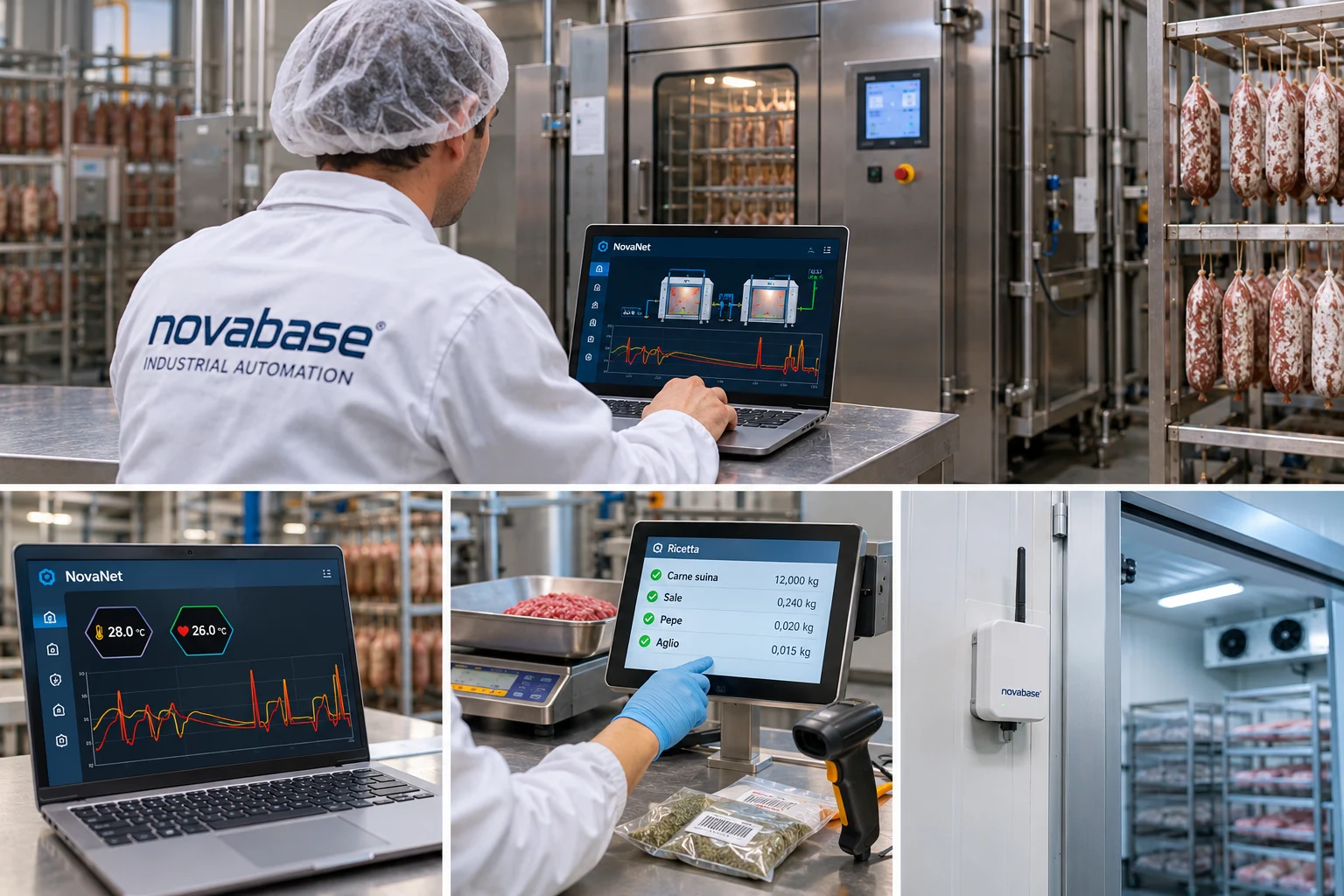
From probe calibrations to the supervision of ovens and cold rooms, up to the digital management of weighings and batches: a project developed to connect department activities and production information.
In a sausage factory, information useful for production comes from different points: cold rooms, ovens, scales, supplier documents and recipe cards. When this data remains separate, reconstructing a process may require manual consultations and transcriptions. The project created by Novabase for Pinè Salumi addresses precisely this need, integrating measurement instruments, existing machinery and customized applications with the SCADA platform NovaNet.
The cover image is an illustration generated with artificial intelligence: it does not depict the factory Pinè Salumi, staff or authentic screenshots of the project.
Where the project started from: the calibrations
The collaboration began with calibration of temperature probes used in cold rooms and ovens. The measurement activities have opened a broader discussion on the possibility of collecting and consulting temperatures from a centralized point.
It is important to distinguish the functions: the calibration verifies the metrological behavior of an instrument with respect to appropriate references; the monitoring records the trend of quantities over time. They are complementary activities, not substitutes.
Cold rooms: centralized temperatures and alarms
For cold rooms, refrigerators and freezers, Novabase has introduced an acquisition system with wireless probes, connected to centralized supervision. The need described by the team was simple: to avoid having to consult separate measurement points and have a single location from which to check temperatures.
Integration also includes alarm management, with notifications via WhatsApp as reported in internal interviews. This function supports ordinary data consultation and allows you to report conditions that require attention; thresholds, notification times and operating procedures must be defined based on the needs of the plant.
Two UNI6 ovens connected to NovaNet without replacing the machinery
A second intervention concerned two UNI6 industrial ovens already present in the plant. The ovens had native serial interfaces, but were not integrated into a common data consultation system.
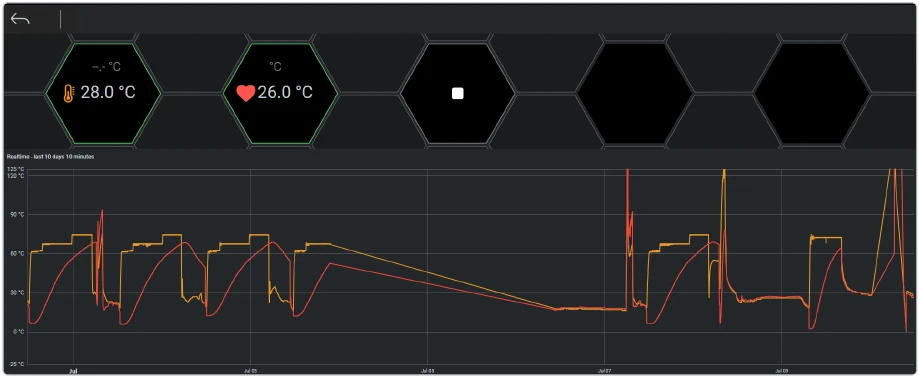
Novabase has achieved serial gateways with customized communication software: the gateway acquires and interprets the data available from the ovens, then transfers them via the network to NovaNet, where they also become accessible through a cloud interface.
The information displayed includes the room temperature and the temperature at the core of the product, together with the historical trends of the cooking cycles. These records support the verification and reconstruction of the processes; they are not equivalent, in themselves, to the validation of a thermal process or the demonstration of the conformity of each batch.
Weighings and recipes: from the paper card to a dedicated application
The most complex intervention concerns the preparation of the recipes. Previously, according to team interviews, operators used paper cards to check ingredients and note any variations; the information was then reported to the administration.
Novabase developed a custom application on an embedded device, with operator interface, serial connection to a scale and barcode reading. The device communicates via Wi-Fi with NovaNet.
During weighing the operator can consult the ingredients included in the recipe, the quantities and associated batches. The system records the processing information and makes it available for subsequent searches. For some raw materials used for a long time with the same batch, the possibility of setting in has also been provided NovaNet a default lot, avoiding repetitive scans when the procedure allows it.
The goal isn't simply to eliminate paper: it is reduce recopying steps and link weighings more directly to production documentation.
Supplier documents and batch search
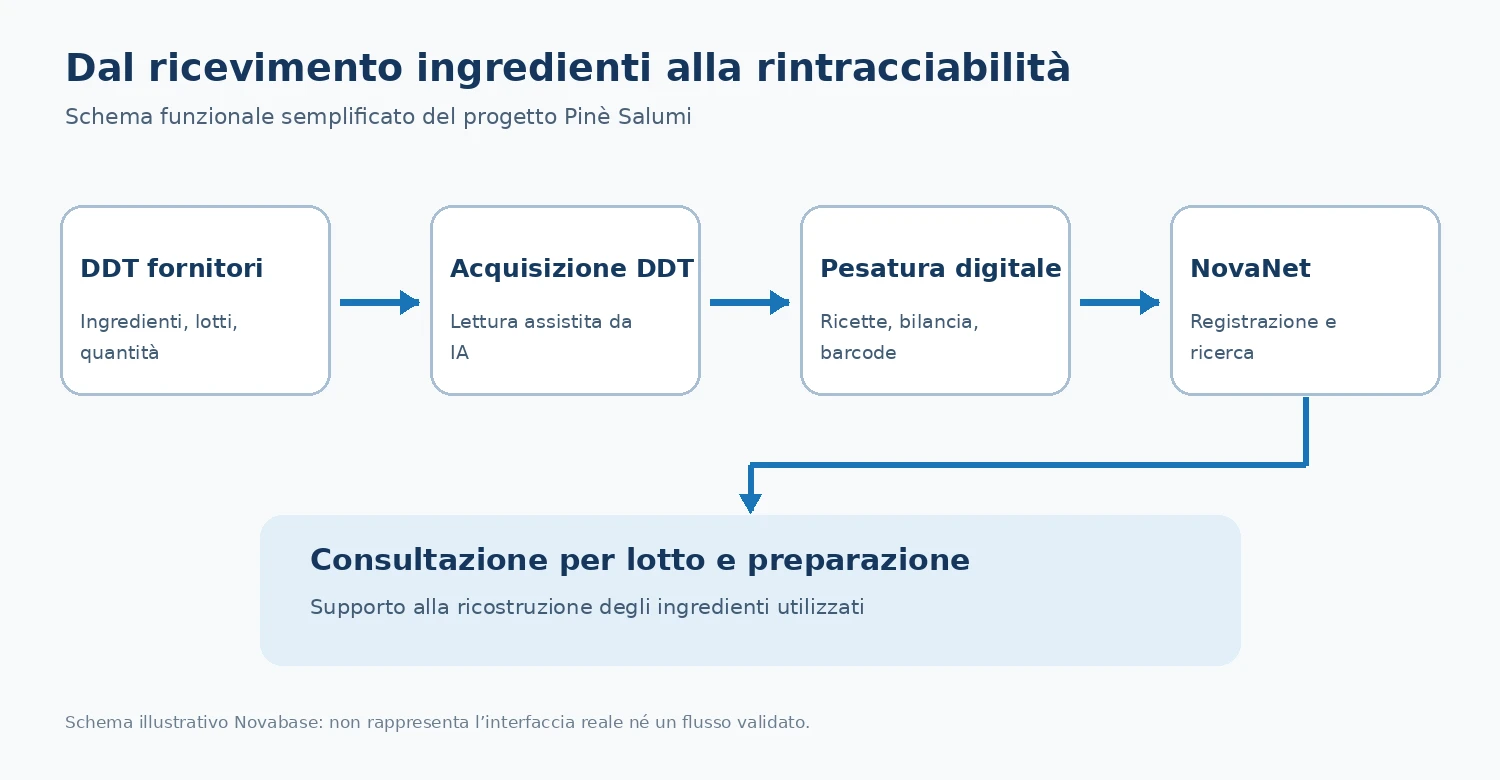
The project also includes a function reading of transport documents (DDT) assisted by artificial intelligence. According to interviews, the system obtains information such as ingredients, quantities and batches received from documents, associating them with the relevant DDT.
This information can be consulted together with the recipe records to trace back from batch of a raw material to the preparations in which it was used. It is a particularly useful function when it is necessary to reconstruct the use of an ingredient following a report from the supplier or an internal verification.
Artificial intelligence-assisted DDT recognition involves human validation of the acquired data. The operator verifies the recognized information, including documents, batches and quantities, before confirming it in the system.
Why traceability is important in the food industry
The traceability allows you to reconstruct the path of foods and ingredients through the phases of the supply chain. In the European Union the general framework is defined byarticle 18 of Regulation (EC) no. 178/2002. The hygiene and self-control procedures based on the HACCP principles are regulated, among other things, by Regulation (EC) no. 852/2004.
A computer system can support recording and searching for the necessary data, but does not replace the responsibilities of the food operator, checks on the data acquired or self-control procedures.
A project built in phases
The case Pinè Salumi shows how a digitalisation path can arise from a limited need - the verification of measurement instruments - and progressively extend to more department activities.
| Area | Intervention carried out | Operational utility |
|---|---|---|
| Temperature instruments | Calibration of cell and oven probes | Verification of measurements |
| Conservation | Wireless probes, centralization, alarms | Unified temperature consultation |
| Cooking | Gateway for two UNI6 ovens e NovaNet | Access to historical metrics and graphs |
| Preparing recipes | Embedded application, scale, barcode | Digital recording of ingredients and batches |
| Receipt of raw materials | AI-assisted DDT reading | Connection between documents, batches and processes |
Conclusion: integrate before replacing
The experience Pinè Salumi highlights a concrete approach: connect already operational machines, acquire available data and digitize manual steps where they are really needed. In this project NovaNet it acts as a supervision platform, supported by gateways and applications developed for specific needs.
If you are considering how to integrate ovens, cold rooms, scales or traceability processes into your factory, contact Novabase to examine the existing architecture and integration possibilities.
Sources and references
- Novabase, Platform NovaNet – Digital Revamping & Interconnection of Existing Systems, technical brochure provided for the project Pinè Salumi, pp. 1–2 (internal, non-public source).
- Novabase, three transcripts of internal interviews from November 2, 2026, provided for the preparation of the case study (internal, non-public sources; text derived from voice recognition, with possible inaccuracies).
- European Union, Regulation (EC) no. 178/2002, article 18, general principles of traceability.
- European Union, Regulation (EC) no. 852/2004, food hygiene and procedures based on HACCP principles.