


Thermal mapping of blood refrigerators: method, risks and documentation
Mapping of refrigerators for blood and blood components: measurement points, loading, openings, traceability and data interpretation.
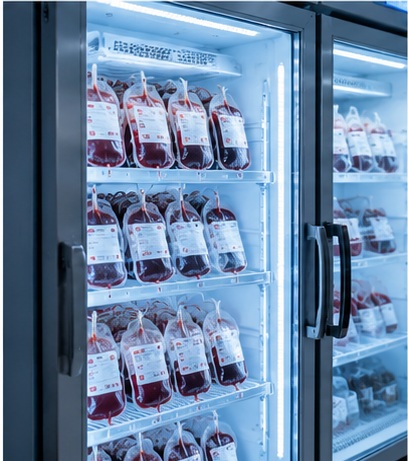
Digitally generated illustrative image; does not document a specific Novabase installation.
An application with specific needs
In refrigerators intended for storing blood and certain blood components, temperature control is a central element of risk management. It is not enough to observe the value indicated on the display: you need to know if the temperature is sufficiently uniform in the positions actually used. Novabase has experience in mapping activities on blood refrigerators; a technical article, however, must distinguish what has actually been verified in the field from what would require a more extensive qualification of the equipment.
Mapping and qualification: terms not to be confused
A heat map documents the temperature distribution during a defined test. An equipment qualification may require additional verifications, documents, acceptance criteria, deviation management and approvals required by the facility's quality system. It is not correct to automatically present a mapping as a complete qualification. Purpose, responsibility and applicable references must be clarified before the measurement campaign.
Define conditions and requirements
The protocol must identify the type of equipment, stored products, applicable thermal range, capacity, shelves and usage configuration. Storage requirements change depending on the blood component: a single interval should not be applied indiscriminately to whole blood, red blood cells, plasma or platelets. The operational reference is the facility's approved procedures and relevant provisions. Acceptance criteria must be established before examining the results.
How to deploy sensors
The measurement points should represent the areas actually occupied by the products and those potentially critical, for example at the top, at the bottom, near the door or the air supply and return areas, without hindering normal operation. Number and position of probes must be justified based on geometry and risk, not chosen as a universal scheme. When appropriate, thermal simulants are used to represent the response of the contents, always distinguishing the air temperature from the temperature of the simulant.
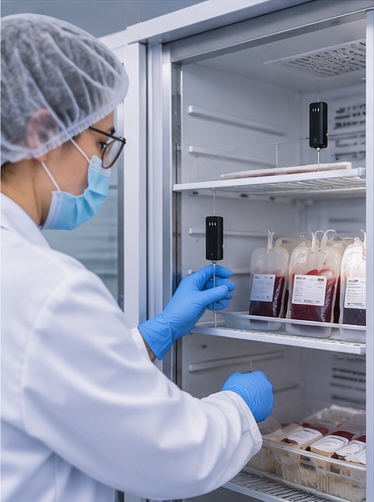
Digitally generated illustrative image; configuration and devices to be verified in the field.
Empty and loaded in blood refrigerators
An empty test can provide basic information on the behavior of the equipment. The load test is useful for representing the conditions of use, as long as the load is defined and documented. Thermal mass and placement of bags or simulants can change response times and airflows. It is advisable to avoid interrupting or compromising the conservation of clinical products: the test methods must be agreed with the responsible staff and with the procedures of the facility.
Door openings, recovery and alarms
When predicted by the test plan, door opening events and subsequent thermal recovery can help characterize the refrigerator's response. Similarly, any checks of alarms or abnormal conditions are distinct activities, to be defined and authorized separately. Failures or failures should not be simulated on equipment containing clinical products without a prior risk assessment and approved procedure.
Traceability of measurements and data integrity
The instrumentation must be suitable for the thermal field, identifiable and accompanied by calibration documentation suitable for the purpose. The analysis also considers uncertainty, resolution, acquisition interval and possible data losses. A wireless system can simplify the positioning of measurement points, but radio coverage in a metal refrigerator and data availability must be verified. The NovaSensor page describes a design approach to measurement integration, not a set of specifications automatically valid for each probe.
The report that the quality manager needs
The result should be reproducible and verifiable: refrigerator identification, protocol, load configuration, point pattern, instrument identifiers and metrological references, time series, events, minimums and maximums, comparison with the criteria, any deviations and conclusions limited to the tested conditions. The information must be presented so that the quality manager can understand its limitations and operational implications.
Frequently asked questions
Is it enough to read the display? No: the display does not necessarily characterize all positions. Does a mapping demonstrate the compliance of any blood component? No: specific criteria are needed for the intended use. Can wireless probes be used? Yes, if suitable, documented and verified in the concrete configuration. When to repeat the tests? According to risk, changes, maintenance and applicable procedures.
Learn more with Novabase
The NovaSensor wireless probes allow you to design the collection of field measurements according to the application. To define instruments, measurement points and integration methods, consult NovaSensor or contact Novabase.