


Thermal mapping at no load and at load: differences, method and selection criteria
Understand when to perform thermal mapping at no load or load, which parameters to measure and how to interpret oven and cell results.
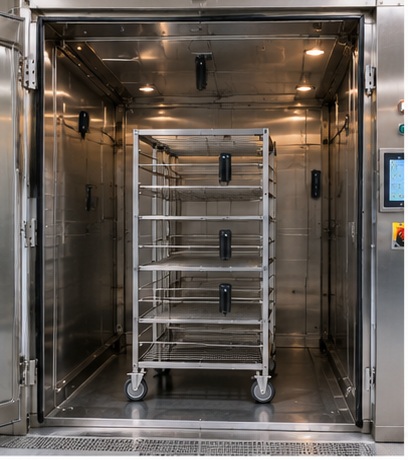
Digitally generated illustrative image; does not document a specific Novabase installation.
Because the load condition changes the result
A thermal chamber does not necessarily behave the same way when it is empty and when it contains product. A load modifies heat exchange, hinders or directs air flows and introduces thermal inertia. For this reason, thermal mapping must start from a concrete question: do we want to know the performance of the system in controlled conditions or verify its behavior during actual use? The answer determines test configuration, measurement points, duration and evaluation criteria.
What does vacuum mapping measure
The no-load test characterizes the temperature distribution in the working environment without significant product load. Empty trolleys and shelves can remain installed in an industrial oven, because their geometry can also influence air circulation. In a cold room, areas close to the door, the evaporator, the walls and at different heights are analysed. We look for hottest and coldest spots, control oscillations and settling times. The exact configuration must be described in the protocol: «empty» does not always mean «without any accessories».
What load mapping adds
The load test considers real products or representative simulated loads, documenting their quantities, distribution, dimensions and initial state. It can highlight differences that are not observable when empty, for example areas shielded by the product or longer recovery times. It is essential to distinguish the probes that measure the air from those inserted in the product: the former describe the thermal distribution of the environment; the latter measure the thermal response of the product. It is complementary information, not interchangeable.
A credible measurement protocol
The typical path includes definition of the objective, inspection, choice of representative and critical points, verification of the instrumentation, acquisition for a suitable period, recording of events and analysis of the results. The measurement points are not chosen with a fixed number valid for each system: they depend on volume, geometry, circulation, conditions of use and client requirements. Setpoint, load, openings, cycle phase, sampling frequency and identification of each probe must be noted. The instruments must be suitable for the measurement field and accompanied by metrological evidence consistent with the purpose.
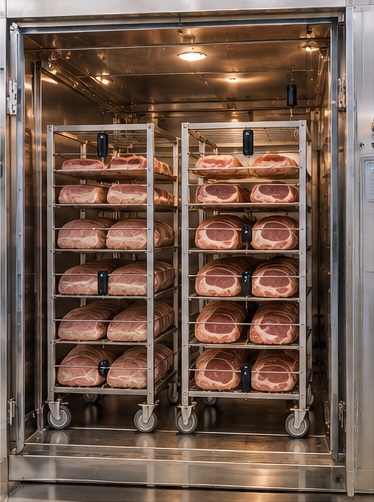
Digitally generated illustrative image; configuration and devices to be verified in the field.
How to read the results
The report should present probe locations, time series, minimum and maximum temperatures, spatial dispersion, any critical points, and comparison to acceptance criteria defined prior to the test. A difference between two sensors is not automatically a non-conformity: what matters is the process objective, the measurement uncertainty and the applicable requirement. When appropriate, multiple load configurations are compared, avoiding generalizing the result beyond the conditions actually tested.
Wireless probes and data collection
The NovaSensor and Novabase solutions are designed to acquire field measurements and integrate them with monitoring systems defined according to the project. The absence of cables facilitates positioning in accessible points and reduces operational space; However, it does not eliminate the need to verify thermal suitability, autonomy, data integrity and radio communication behavior in the presence of metal walls. The availability of local recording or real-time transmission should be verified for the specific model and configuration used.
When to choose one test, the other or both
Vacuum mapping is useful for initial characterization and repeatable comparisons of the system. The dependent one is particularly significant when the benefit depends on actual employment. In more complex projects the two conditions are studied together, with separate objectives and criteria. Novabase can help define an acquisition and analysis strategy proportionate to the process, without transforming a single test into a universal guarantee of compliance.
Frequently asked questions
How many probes are needed? There is no universally valid number: the positioning plan must be justified. Does a loaded mapping replace the unloaded one? Not necessarily: it answers a different question. Can a wireless system be used? Yes, as long as it is suitable for the operating conditions and guarantees the required data quality. How often should you repeat the mapping? The frequency depends on risk, plant changes, procedures and applicable requirements.
Learn more with Novabase
The NovaSensor wireless probes allow you to design the collection of field measurements according to the application. To define instruments, measurement points and integration methods, consult NovaSensor or contact Novabase.