


Thermal mapping of cold rooms: hot spots, loading and monitoring
How to design a mapping of cold rooms, choose measurement points and evaluate uniformity, load and door opening; including Novabase SmartCold and NovaCold solutions for cold chain monitoring.
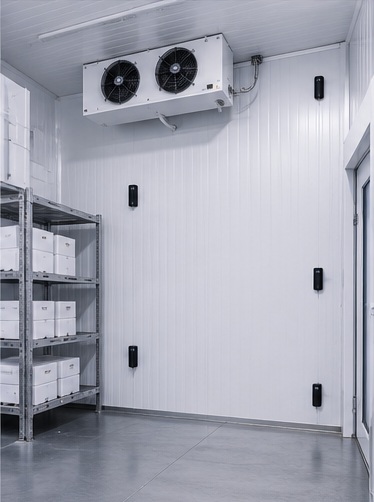
Because reading the display is not enough
The display of a cold room represents the measurement of a regulation probe, not necessarily the temperature of all points of the useful volume. Proximity to the evaporator, shelving, doors, loading and arrangement of products can create areas with different behaviors. A thermal mapping serves to characterize this variability under defined conditions, identifying critical locations and supporting storage decisions.
What to define before starting
The protocol must clarify intended use, required temperature range, geometry of the cell, quantity and arrangement of products, number of accesses, defrost regime and relevant external conditions. The choice of sensors must cover the plausibly hottest or coldest points and a representative set of the useful volume. In large cells with racking, positioning across multiple heights and aisles is often more informative than a simple line of sensors in the center.
Dry run: get to know the system
With the cell without the normal product load, the behavior of the refrigeration system, stabilization, spatial differences and the influence of the defrost cycles are studied. It is necessary to describe whether shelves, pallets or other obstructions are present: they are elements that can change the circulation of air. The empty test is useful as a reference, but does not automatically describe the behavior of the cell when full.
Test under load: representative conditions
The thermal mass of the products and obstacles to the air flow change the response of the cell. A load test must therefore specify percentage of occupancy, type of commodity or simulant, arrangement and initial temperature. The choice of load must be consistent with the objective: a very favorable condition does not demonstrate stability in all operational scenarios. When usage varies significantly, it may be necessary to consider multiple configurations.
Doors, defrosts and temperature recovery
Door openings and defrost cycles can generate significant transients. If they are part of the protocol, it is useful to record the moment of the event, the duration, the response of the different sensors and the time to return to the expected conditions. A temporary increase in temperature should not be judged in isolation: it must be compared with criteria relevant to the stored goods and operating procedures.
How to use wireless probes
Wireless probes and recorders facilitate installation in different points of the cell without preparing long cabling. The NovaSensor page describes the collection of field measurements and the integration of the monitoring link according to the project. However, in an environment with metal walls, shelves and goods, it is necessary to check radio coverage, data continuity, autonomy and correct identification of the sensors. Real-time transmission and any local memory depend on the configuration adopted.
What the report must contain
A useful technical document contains a plan with measurement points, characteristics of the instruments and their metrological status, setpoint, load conditions, duration, sampling interval, events, graphs and temperature table per point. The interpretation must distinguish normal variability from any deviations from the agreed criteria. If critical areas are identified, the report can support the revision of storage rules or further checks of the plant.
Mapping and continuous monitoring are not synonymous
Mapping is a measurement campaign designed to describe the spatial and temporal behavior of the cell under defined conditions. Continuous monitoring, on the other hand, is an operational safeguard over time, often with fixed points and alarm management. The two activities are strengthened: mapping also helps to choose where to place the permanent control probes. For monitoring the cold chain Novabase presents vertical solutions such as SmartCold e NovaCold, to be evaluated according to the application.
Frequently asked questions
Where are the probes placed? In the representative and potentially critical points, justifying the choice. How long does the test last? It depends on the system cycles and the conditions to be observed. Does the cell have to be empty? Not always: load testing is often essential to describe actual use. Is a single fixed probe sufficient? It can serve operational control, but does not replace spatial mapping.
Learn more with Novabase
The NovaSensor wireless probes allow you to design the collection of field measurements according to the application. To define instruments, measurement points and integration methods, consult NovaSensor or contact Novabase. Also evaluate solutions dedicated to monitoring such as SmartCold e NovaCold for the continuous management of the cold chain.