


Integrating machinery from different manufacturers: practical guide for industrial plants
Checklist and practical path to integrate machinery from different manufacturers: signal mapping, protocols (OPC UA, MQTT), data model, safety and testing. Included list of recommended images for communicating the project. For advice, contact Novabase.
Integrating machinery from different manufacturers is an activity that goes beyond the technological choice: it requires first of all the clear definition of the operational problems that you want to solve. This article provides a practical checklist and a proposed path to make production data readable and usable, minimize risks and obtain measurable results in the field.
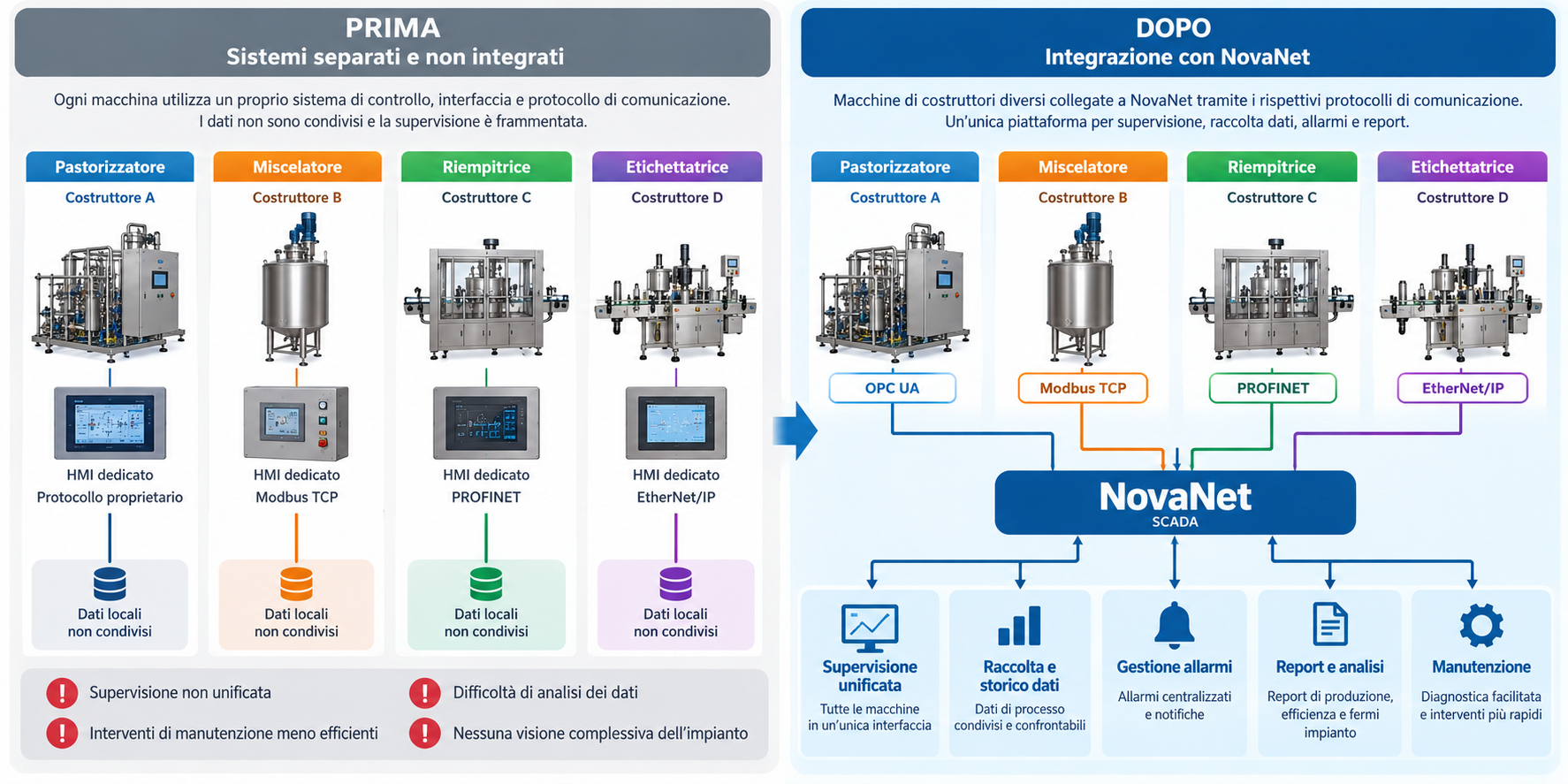
1. Phase 0: define objectives and KPIs
Before any software or hardware intervention, establishing what you want to achieve makes the project verifiable. Some examples of objectives and KPIs:
- Traceability: collection of timestamped events for each machine cycle.
- OEE and downtime: Identify the root causes of downtime.
- Quality: correlate machine parameters with waste or rework.
- Compliance and audit: Maintain immutable and searchable records.
2. Data collection and signal mapping
A complete signal map is the practical prerequisite for integrating machinery from different manufacturers. Operational steps:
- Device inventory: PLC, HMI, motor controllers, sensors, manual recordings.
- Catalog tags and variables: addresses, type (boolean, analog, string), update frequency.
- Define machine states and relevant events (start, stop, error, recipe change).
- Establish rules for alarms, recipes, and user permissions.
Collect at least one representative cycle under real operating conditions to validate the mapping.
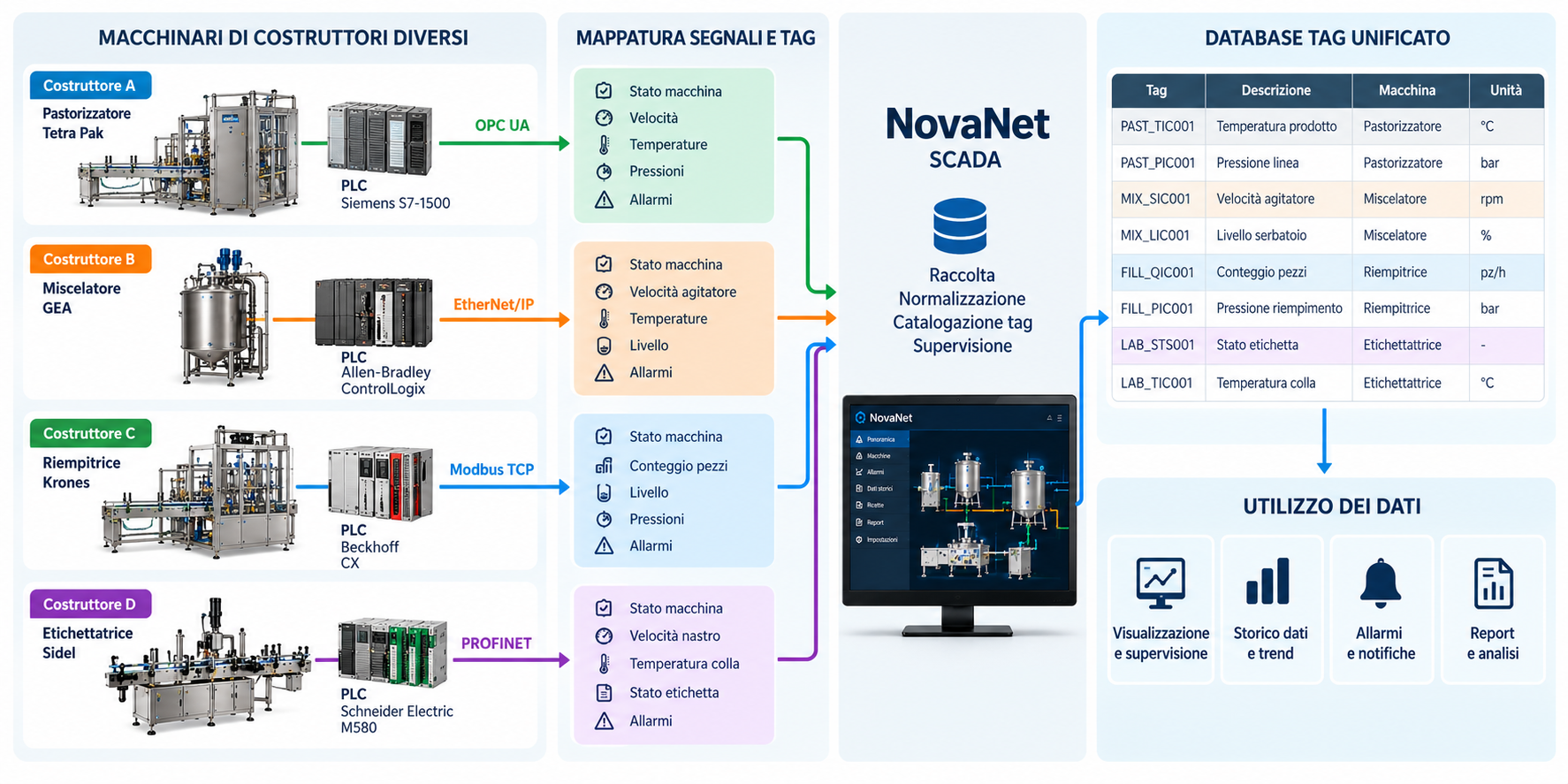
3. Recommended architecture and protocols
To manage heterogeneity it is useful to adopt a normalization layer between field and company systems:
- Edge gateway / protocol gateway: translate Modbus, EtherNet/IP, Profinet, CAN, etc. in standardized protocols.
- OPC UA for structured telemetry and node discovery; MQTT for events and light telemetry.
- Historian or time-series databases to maintain data with reliable timestamps.
- Time synchronization: NTP or PTP to align events between different machines.
This layering allows you to connect consistently SCADA, MES and analytical solutions without modifying the original controllers.

4. Data model, machine states and recipe management
A consistent data model simplifies supervision and analysis:
- Define one state model shared (e.g. Idle, Running, Pause, Fault).
- Associate metadata with raw data: source, frequency, unit of measurement, accuracy.
- Version recipes and track changes (who changed what and when).
- Design operator screens that show only what is needed, avoiding information overload.
5. Safety, testing and validation
Security and validation are key when integrating your facility:
- Segment the OT/IT network and apply firewalls, access control and VPN for remote access.
- Manage credentials, roles and privileges for operators and maintainers.
- Run tests in a staging environment with approved use cases before go-live.
- Establish rollback procedures and contingency plans in the event of operational regression.
Recommended image: OT/IT security graphics highlighting network segmentation, firewall and access control. Suggested alternative text: “OT/IT Network Security and Segmentation.”
6. Project process and roles
A collaborative approach reduces time and costs:
- Involve operations, maintenance, IT and process stakeholders from the first analyses.
- Define milestones: mapping, prototype, field test, validation, graduated rollout.
- Operational training and intervention manuals: supervision must be approved by the operators who will use it.
- Measure results against initial KPIs and adapt the system in rapid cycles (iterations).
Practical example in brief
Before installing a SCADA or connect an MES, Novabase recommends collecting available data, observing a representative cycle and agreeing on test conditions. Only after having defined the signal map, the machine states and the alarm rules can we proceed with the configuration of the supervision system.
Conclusion
Integrating machinery from different manufacturers requires a measurable approach: clear objectives, signal mapping, scalable integration architecture, attention to safety and shared validation. For a specific case, dealing with the Novabase technical team helps transform complexity into operational value. Visit the Journal Novabase for further information and use cases.
For targeted advice on your system or to request technical support, contact us via the form on our website: https://www.novabase.it/#contattaci.